
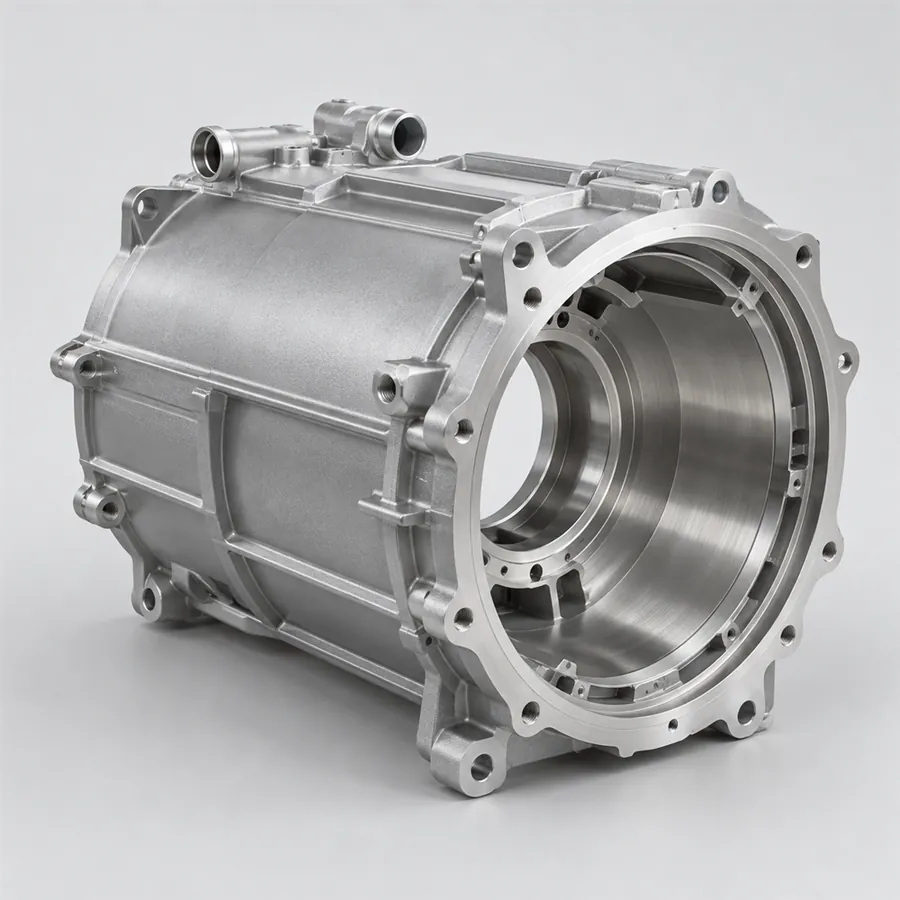
Projects / E-drive and actuator housings

EV motor, PDU and robot joint housings: round enclosures that have to seal

All three parts are EV motor housings, round or near-round, and all three have to keep water out and, on two of them, keep heat moving. What decides whether they work is not the shape: it is the roundness after machining, the gasket groove tolerance and the path the heat takes from a die-cast wall to the air.

Alloy
A380 / ADC12
Wall
2.5–4.0 mm
Roundness
0.05 mm after machining
IP target
IP54–IP67 by design
Reference design

Reference design, not a delivered customer project.

This page describes a part family and the engineering decisions it forces. It is built from the geometry class and the process route, not from one customer order: no part number, customer name, delivery date, yield figure or measured result is shown.

Delivered project data is published only with the customer written authorization, and none of these images are customer photographs.

01 / Family

One EV motor housing geometry, three duty cycles.

The family is joined by geometry — a cylinder closed at one or both ends — and divided by what has to be proven at release.

MemberAlloyTypical wallWhat decides acceptanceRelease test
EV motor housingADC123.0–4.0 mmBore and end-face roundness; cooling jacket tightness; stator seat diameterCMM roundness, 100% jacket leak test
PDU enclosureA3802.5–3.5 mmGasket groove section; flatness of the lid face; earth continuity pointsAir-decay seal test, torque check on inserts
Robot joint housingADC12 or A3802.5–3.5 mmBearing seat roundness and coaxiality; wall stiffness under torqueCMM coaxiality, dimensional report per lot
IP ratings quoted here are design targets agreed per project. A rating is only claimed after the assembled enclosure has been tested to the agreed method.
02 / Context

Why the casting is rarely the constraint.

On a motor housing, the leak almost never comes from a hole in the casting. It comes from the machined interface: an O-ring groove cut too shallow, a flange that springs after clamping, or a sealing face that was interrupted by an ejector pin. On a PDU enclosure the same is true of the lid face, and on a joint housing the audible problem is usually roundness, not porosity.

  • Design the seal as a machined groove, not as an as-cast step
  • Keep ejectors off every face that touches a gasket
  • Measure roundness after machining and after clamping, not before
03 / Design

Four decisions for round, sealed enclosures.

A DFM review on this family settles these before the die layout is frozen.

Sealing concept

A cast groove with 0.1 mm tolerance is expensive to hold; a machined groove in a faced flange is cheaper and repeatable. We propose which one applies once the lid interface is known.

Roundness after machining

A thin cylindrical wall deflects under chuck pressure. Parts are machined in a fixture that supports the wall, and roundness is measured relaxed, not in the fixture.

Thermal path

Fins only help if the heat reaches them. Where a stator or a busbar sits, the wall thickness between the hot face and the fin root matters more than fin count.

Jacket construction

A cooling jacket can be cast as a channel, machined from a thicker wall, or formed with an inserted sleeve. Each changes the die, the leak test and the scrap value of a reject.

04 / Route

From die to a sealed assembly.

Sequence for this family, with the point where the sealing decision is actually made.

StageWhat happensControl point
DFM and sealing reviewGasket or O-ring concept, flange section, machining allowance on the seal faceGroove section and tolerance fixed before tooling
Die build and T1Parting, slides for ports, cooling layout, vacuum assist if the wall is thinT1 porosity check on the seal band and the jacket wall
MachiningFaced flange, machined groove, bearing seats in one or two setupsRoundness and groove depth on the CMM, not a plug gauge
Seal and leak testAir decay on the assembled or capped enclosurePressure, hold time and rate agreed at first article
FinishingConversion coating, powder coat with masking on seal faces and earth padsMasking verified before cure, continuity checked after
Assembly and testing of the customer electronics stay outside our scope unless agreed in writing; we test the casting and the machined interfaces we supply.
05 / Failure modes

Where sealed enclosures leak or lose roundness.

Causes we see repeatedly on this geometry class, and what removes them.

RiskMechanismCountermeasure
Leak at the flangeFlange springs when the lid is torquedThicken the flange to 8–10 mm, add ribs behind it, specify flatness after machining
Groove too shallow after coatingPowder thickness added on a groove that was already at the lower limitMask the groove, or specify groove depth after coating
Out-of-round after machiningChuck pressure on a 3 mm wallSupport fixture, lower clamping force, measure relaxed
Jacket leakPorosity in a cast channel wallVacuum assist, thicker jacket wall, or a machined path instead of a cast one
Earth continuity failConversion coating over an earth padMask the pad or machine it after coating
06 / Inspection

What gets measured on a round enclosure.

The plan for this family is short and specific: geometry that moves under clamping, and sealing surfaces that only fail under pressure.

CharacteristicMethodFrequency
Roundness of bore and end faceCMM, part relaxedFirst article and per lot
Coaxiality of two bearing seatsCMM against the datum axisFirst article and after fixture change
Gasket groove depth and widthCMM or profile gaugeEvery lot
Flange flatnessCMM or surface plateEvery lot after machining
Seal integrityAir decay on capped part100% where specified
Wall thickness in the jacketUltrasonic check or sectioningFirst article plus periodic audit
Roundness and flatness are reported on the relaxed part. A measurement taken in the fixture describes the fixture, not the part.
07 / Inputs

What makes an e-drive housing quotable.

For this family the drawing is only half the input. The sealing concept, the thermal requirement and the assembly torque determine the die and the machining fixture, so we ask for them at the RFQ stage rather than after the tool is cut.

Send with the RFQ

  • 3D model plus 2D drawing with datum and tolerance class
  • Gasket or O-ring specification, including groove dimensions if already chosen
  • Thermal requirement: heat load, allowed case temperature, contact area
  • Assembly torque and the fastener pattern for the lid or end plate
  • IP target and the test method the customer will use to verify it
  • Annual volume and whether the part is machined in-house or elsewhere
Buyer questions

E-drive and enclosure questions

What buyers ask before releasing a round, sealed housing.

The casting holds the geometry; the seal holds the rating. An IP67 claim is made on the assembled enclosure tested to an agreed method. What we control is the machined groove section, the flange flatness and the surface finish on the sealing band, and those are what make the seal repeatable rather than lucky.

A cast jacket is cheaper per part at volume but needs vacuum assist and a thicker wall, and a leak in a cast channel usually means a scrapped casting. A machined path costs more cycle time but is predictable and can be reworked. We recommend one or the other after seeing the jacket geometry and the annual volume, not by default.

On a housing that is machined afterwards, 2.5–3.0 mm is a practical floor for a 200 mm diameter part because the wall has to survive clamping and handling. Below that the roundness after machining, not the fill, becomes the limiting factor.

Bearing seats are always machined. As-cast tolerance of ±0.05 mm is an order of magnitude away from what a bearing seat needs, and the seat also has to be coaxial with the other seat, which only a machining setup can guarantee.

The 3D model, the lid or gasket interface, the IP target and the earth points. Without those the quotation is a price for a shape rather than a price for a part that will pass its test, and the difference usually shows up as a change order after T1.

Send the housing and the seal concept.

We answer within 30 minutes during Shenzhen business hours with a price direction or the questions we still need answered.

Start an RFQ
Upload drawing