
Application review
Confirm the operating environment, target market, assembly requirement and commercial volume.
Heat sinks, lamp bodies and fixtures where fin geometry, flatness, finish and heat transfer are part of the design intent.
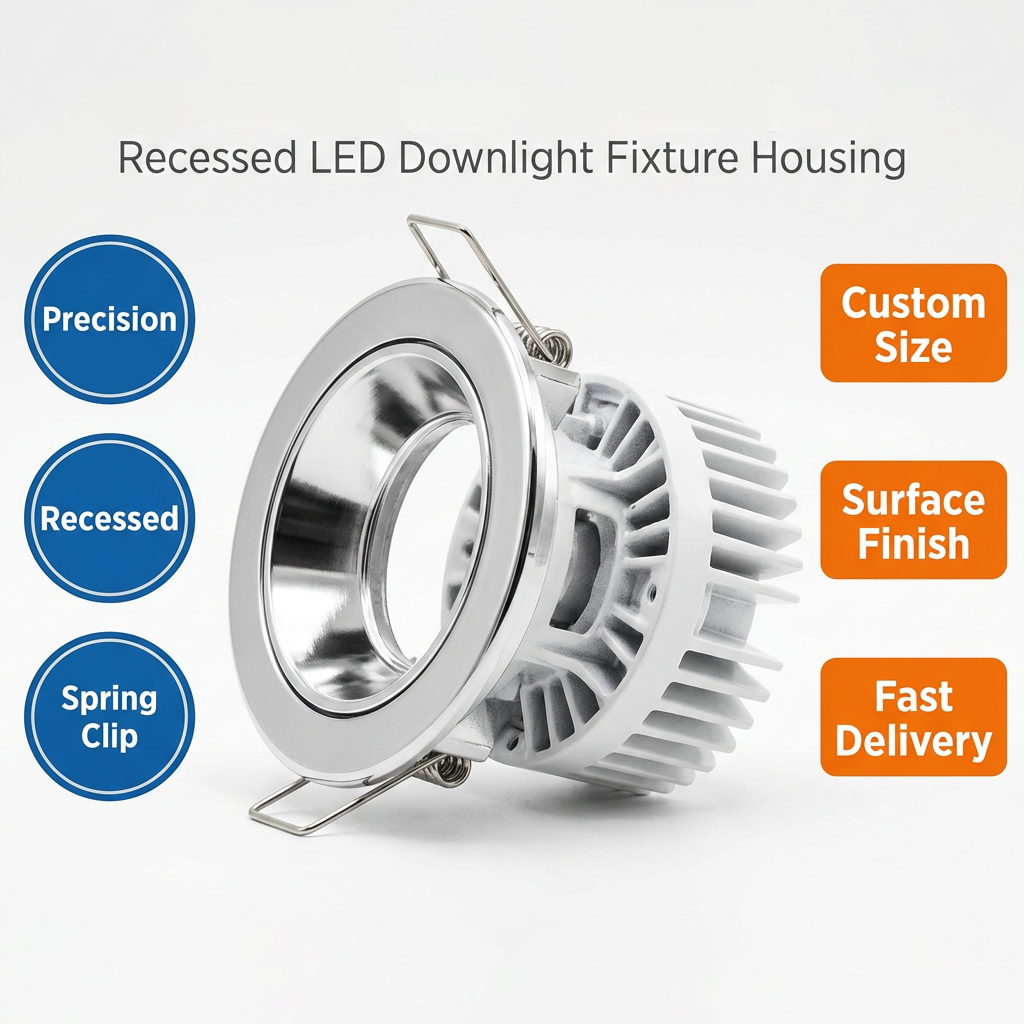 LED lighting and thermal management component planning
Heat sinks, lamp bodies and fixtures where fin geometry, flatness, finish and heat transfer are part of the design intent.
Each project should answer both commercial and engineering questions: how the part will be produced, how it will be inspected, how the program will be released and what evidence is needed for the target market.
Use this table for project planning, then confirm every critical value against the approved drawing and process plan.
| Typical parts | High-bay and street-light parts, Spotlight housings, Downlight bodies, Heat sinks and covers |
|---|---|
| Recommended materials | ADC12, A380, AlSi10Mg |
| Primary process | High-pressure die casting with secondary operations |
| Critical focus | Drawing-specific: dimensional, sealing, thermal, shielding or structural requirement |
| Quality documents | Defined by customer and application requirements |
| Quality system | ISO 9001 and IATF 16949 certified factory |
Each stage produces a decision or document that the next stage depends on. This keeps engineering, purchasing and production aligned.
Confirm the operating environment, target market, assembly requirement and commercial volume.
Check material, geometry, sealing, thermal behavior and secondary operations.
Approve the tooling, sample, machining and finishing plan before volume release.
Define the inspection plan, traceability and release documents required by the project.
These answers define the normal project path and the information needed for a useful quotation.
Provide the controlled 2D/3D drawing, material requirement, annual quantity, finishing requirement, critical dimensions, target market and delivery date.
An initial feasibility discussion is possible, but the quotation and tooling scope should be based on a controlled drawing revision.
Tolerance and inspection requirements are defined from the drawing, critical features, process capability and agreed datum strategy.
Ownership, storage, maintenance and transfer terms are defined in the quotation or supply agreement before the tooling project starts.
Use the internal links to connect the material, process, industry, product and RFQ pages around one project decision.
Include the material, annual quantity, finishing requirement, target market and delivery date. The review can start from STEP, IGS, DWG, DXF, PDF or ZIP files.