
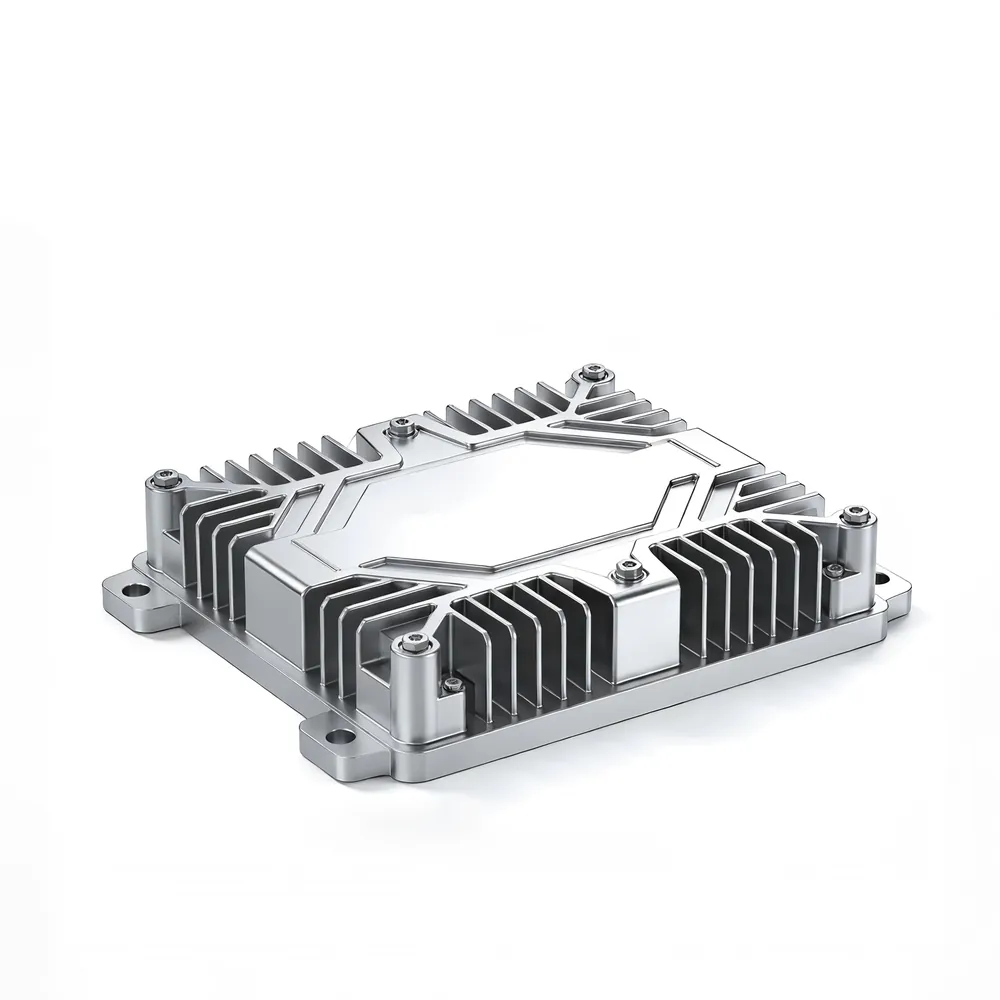
Material / Aluminum A360 (AlSi10Mg)

A360 aluminum die casting: corrosion resistance and ductility, at a price

A360 trades some fluidity and machinability for corrosion resistance and elongation. It is the alloy to quote when your part is seen outdoors, anodized, or expected to bend before it breaks.

A360 Aluminum Die Casting material review A360 Aluminum Die Casting material review
0.45–0.60%
Magnesium, the corrosion element
≈ 317 MPa
Typical as-cast tensile strength
≈ 3.5%
Elongation, twice ADC12
555–615 °C
Melt temperature window
01 / Why this alloy

What A360 is chosen for

A360 is AlSi10Mg: silicon around 9–10%, magnesium 0.45–0.60%, copper held under 0.6%. The magnesium is the point. It improves corrosion resistance and lets the part take a clear anodized film, which A380 and ADC12 cannot do cosmetically.

In practice A360 appears where the service environment is wet or saline, where the finish is anodized rather than painted, or where your part has to survive a hit without cracking. Outdoor enclosures, marine hardware, hydraulic bodies and antenna brackets are typical.

The trade-offs are real. Fluidity is lower than A380, so thin walls need a hotter die and a faster fill; the alloy is gummier to machine; and it costs more per kilogram because it is a less common grade in the scrap stream.

  • Outdoor and marine housings
  • Parts that must be anodized, clear or black
  • Hydraulic valve bodies and manifolds
  • Antenna and mounting brackets
  • Any part where elongation below 2% fails the design case
02 / Composition

Typical composition and what each element changes

Ranges follow the common A360 family. Magnesium is the element that distinguishes it from A380, and it is also the one that makes the melt harder to run.

ElementTypical range, wt%What it controls
Si9.0–10.0Fluidity and wear; slightly less than ADC12
Mg0.45–0.60Corrosion resistance, anodizing response, strength
Cu≤ 0.60Kept low on purpose: copper is what ruins anodizing and corrosion resistance
Fe≤ 1.30Die sticking versus brittle phases
Mn≤ 0.35Iron-phase control
Zn≤ 0.50Tramp; higher levels hurt corrosion resistance
Ni≤ 0.50Tramp
Sn≤ 0.15Tramp; lower is better
AlbalanceThe matrix
Because copper is deliberately low, A360 is sensitive to contamination from A380 scrap in the same furnace. Melt practice and furnace segregation are part of the material control, not an afterthought.
03 / Properties

Mechanical and physical properties, as cast

Typical values for separately cast test bars. Thin sections and high porosity move them down.

PropertyTypical valueHow the drawing uses it
Ultimate tensile strength≈ 317 MPaSection sizing and bolted joints
Yield strength, 0.2%≈ 170 MPaClamp load
Elongation≈ 3.5%Impact and drop cases; the reason to choose A360
Hardness≈ 75 HBMachining feeds, wear
Density2.63 g/cm³Part weight, slightly lighter than A380
Thermal conductivity≈ 113 W/m·KBetter heat spreading than A380
Melting range≈ 555–615 °CNarrower window; die temperature control matters
Thermal conductivity is one reason A360 appears in heat-spreading covers: the magnesium-bearing matrix conducts better than A380 while keeping the corrosion benefit.
04 / Casting behavior

How A360 behaves inside the die

Lower fluidity, hotter die

A360 does not fill as far as A380 at the same gate velocity. The practical fix is a die running 200–250 °C, a slightly faster fill in the thin sections, and gates placed so the last metal to arrive is in an overflow rather than in a sealing face.

On a 1.0 mm wall, A360 is usually run at the top of its die-temperature window. A cold die shows it first as a cold shut in the corner farthest from the gate.

Sticking and soldering

Magnesium-bearing aluminum alloys solder to the die more readily than A380, especially on deep cores and sharp edges. Die coatings, polished cores and a controlled release agent are the routine countermeasures.

Draft below 1° on a deep core is where sticking starts. A360 is less forgiving than A380 here, so draft is agreed during DFM rather than left to the toolmaker.

Shrinkage and pressure tightness

Linear shrinkage is 0.5–0.7%, similar to the other aluminum die casting alloys. The magnesium content gives good pressure tightness once the gate feeds the sealing face, which is why hydraulic bodies are a natural application.

Leak requirements are specified as a rate at a pressure with a method, exactly as for A380. The alloy helps; the die and the machining of the seal land decide.

05 / Machining and finishing

Machining, finishing and assembly notes

Machining

A360 is gummier than A380. It smears, builds up on the edge and produces long chips unless the tool is sharp, polished and run with a positive rake. Coolant or high-pressure air both work; the mistake is running it dry with a worn tool.

Because the material is more ductile, threads and bores finish cleaner, and the risk shifts from chipping to dimension drift from tool wear. Tool-life monitoring matters more than on ADC12.

Anodizing and coating

Clear and black anodizing work on A360, which is the main reason it is specified for visible outdoor parts. Film thickness is typically 10–15 µm; a thicker film on a die casting becomes brittle and can craze at corners.

Powder coating also works, and the two are often combined: anodize the visible faces, powder coat the rest. Masking plans should be agreed with the coater before the first production lot.

Assembly and inserts

Cast-in inserts and machined threads both work. Because A360 is more ductile, thread stripping is less likely than with ADC12, but the 1.5× diameter engagement rule still applies.

Welding remains a non-production method. Where a joint is needed, the design uses a gasket, a mechanical fastener or adhesive bonding.

06 / Alternatives

Where A360 sits against the other alloys

A360 is chosen for a property, not for a price: it costs more per kilogram than A380 and machines more slowly.

AlloyTensile, typicalElongationPick it when
A380≈ 324 MPa≈ 3.5%Cost and fluidity matter more than corrosion; the part is painted
ADC12≈ 310 MPa1–3%Thin walls and wear; Japanese drawing
Zamak 3 (zinc)≈ 280 MPa10–15%Very thin decorative walls and plating, where weight is not an issue
If the only reason for A360 is anodizing, confirm the finish with the coater before the die is cut: a die casting's surface skin and porosity can make a cosmetic anodic film harder than the alloy data sheet suggests.
07 / Inspection

What is checked on an A360 part

CharacteristicMethodFrequency
Chemistry, especially copperSpectrometer on the meltEvery heat
DimensionsCMM at 0.001 mm, or gaugesFirst article, then per-lot sample
Pressure tightnessAir decay, water or helium100% where specified
Anodic film thickness and colorCoater certificate plus samplePer lot
Porosity in sealing zonesX-ray and sectioningFirst article and periodic
Cosmetic defectsApproved sample under agreed lightEvery lot
Copper contamination is the failure that does not show up until the part is anodized. Melt segregation and a spectrometer check on every heat are what prevent it.
08 / Typical parts

Three parts where A360 is the right call

An outdoor enclosure with a gasket land and a visible anodized face is the archetype: A360 supplies the corrosion resistance for the service environment and the anodic film for the appearance, and the machining plan handles the land.

A hydraulic valve body adds pressure to the same problem. The magnesium-bearing alloy holds tightness once gated correctly, and the lower copper keeps corrosion out of the fluid path when water-based fluid is used.

A marine or coastal bracket is a simpler case: the part is small, the environment is the design driver, and the elongation margin is what stops a crack at a bolt hole from becoming a failure.

Buyer questions

A360 questions that change the quotation

Anodizing, corrosion, machinability and cost are the four answers that decide between A360 and A380.

Three reasons: the part is exposed to salt or moisture, it needs a cosmetic anodized finish, or the design case needs more elongation than A380 comfortably gives. If none of those applies, A380 is cheaper per kilogram and easier to run.

Yes, clear or black, typically 10–15 µm. It is the aluminum die casting alloy that takes anodizing cosmetically, because copper is held under 0.6%. The surface skin and porosity still affect the result, so the coater should see a sample before the first production lot.

Better than A380 and still not a production joining method. Porosity makes weld quality variable; where a joint is structural, the design should use inserts, fasteners or adhesive instead of a weld.

It is a less common grade, so scrap availability and melt segregation cost more. Machining is also slower because the alloy is gummier. The premium is usually worth it only when corrosion or anodizing is a real requirement.

It conducts better than A380 at roughly 113 W/m·K against 96, which is why it turns up in heat-spreading covers. The gain is modest; a 1 mm fin geometry change usually buys more than the alloy change.

Related pages

Where this page connects.

Material, process, product and RFQ pages around the same decision.

Send the drawing. Get the engineering questions first.

Include the material, annual quantity, finishing requirement, target market and delivery date. The review can start from STEP, IGS, DWG, DXF, PDF or ZIP files.

Start an RFQ
Upload drawing