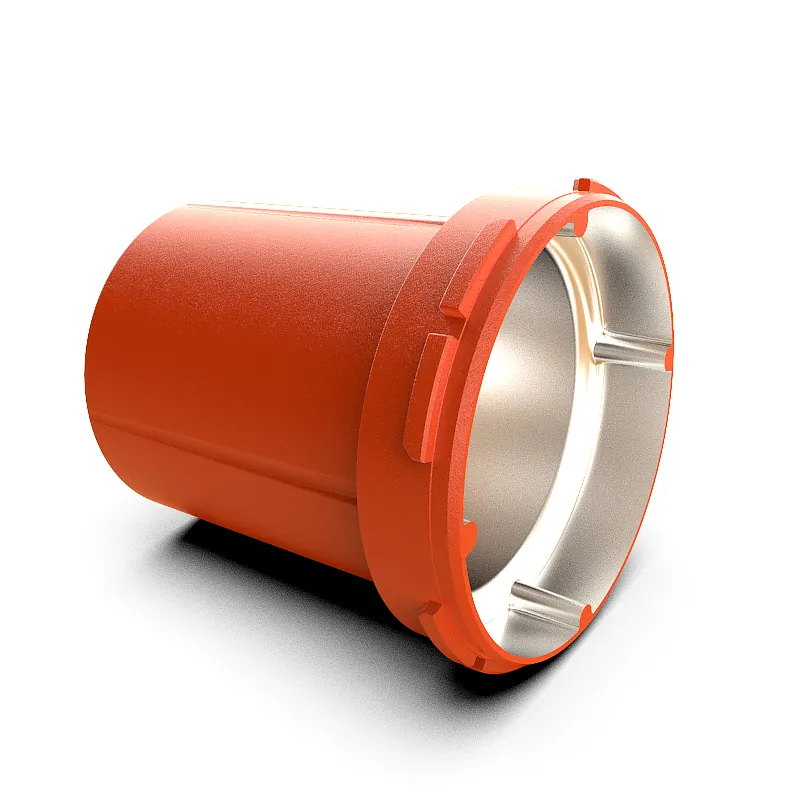
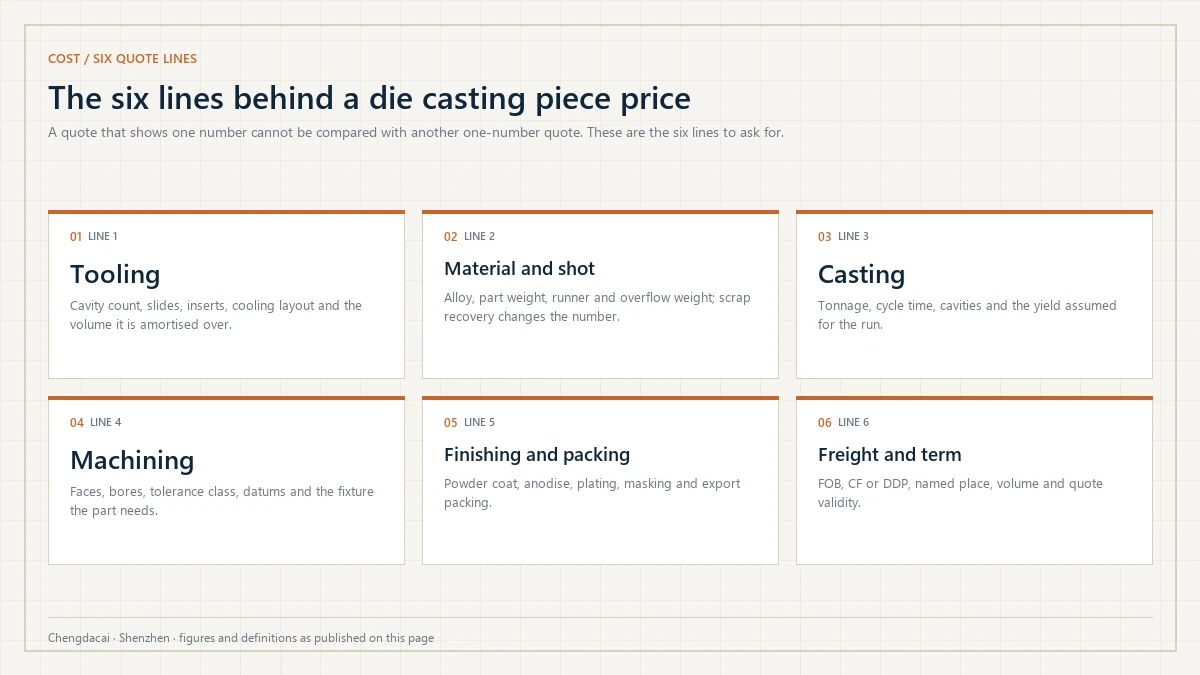
One part, one volume, six lines, every assumption written down. The figures are 2026 planning numbers for a two-cavity aluminum cover — they show how the arithmetic works, not what your part will cost.
| Assumption | Value used | Why it is on the sheet |
|---|
| Finished part | 320 g, A380, as-cast ±0.05 mm | Sets shot weight, machining content and finishing |
| Shot weight | 520 g, a 61.5% yield | Runner, overflow and biscuit are cast on every cycle |
| Machine and cycle | 400 T cold chamber, 45 s, two cavities | 160 good parts per hour at 97% yield |
| Cell rate | $32/h including operator, energy and overhead | The casting line in the quotation |
| Machining | 2.4 min per part on two faces and two bores at $25/h | One fixture, one setup |
| Alloy | A380 ingot $2.35/kg, 2% melt loss, scrap credited at $1.60/kg | Metal is recovered; heat, labor and cycle are not |
| Tooling | Two cavities, two slides, H13, 15–25 days, $42,000 | One-time, invoiced separately from the piece price |
| Finishing and packing | Conversion coat $0.18, export carton $0.06 | Per part, after inspection |
With those assumptions the six lines resolve to the numbers below. Only the material line needs the arithmetic shown; the rest are rate divided by output, or minutes multiplied by a rate.
| Line | This part | How it was calculated |
|---|
| Tooling | $42,000, one-off | Two cavities, two slides, H13; not part of the piece price |
| Material and shot weight | $0.93 | 0.52 kg × $2.35 × 1.02 = $1.25, less 0.20 kg of runner × $1.60 = $0.32 |
| Casting | $0.20 | $32/h ÷ 160 parts/h |
| Machining | $1.00 | 2.4 min × $25/h |
| Finishing and packing | $0.24 | $0.18 conversion coat + $0.06 carton |
| Freight and term | FOB Shenzhen in the price; DDP quoted per shipment | The named place decides who pays freight, insurance and duty |
| Piece price, ex-tooling | $2.37 | The five recurring lines above |
| Tooling per part at 50,000 | $0.84 | $42,000 ÷ 50,000 |
| Unit price at this volume | $3.21 | $10.0 per kg of finished part, against $2.35/kg for the alloy |
Volume is the only line that changes without touching the part. The same drawing, quoted at three annual quantities on the same two-cavity tool, gives three different unit prices:
| Line | 10,000 a year | 50,000 a year | 200,000 a year |
|---|
| Material, net of scrap | $0.93 | $0.93 | $0.93 |
| Casting | $0.20 | $0.20 | $0.20 |
| Machining | $1.00 | $1.00 | $1.00 |
| Finishing and packing | $0.24 | $0.24 | $0.24 |
| Piece price, ex-tooling | $2.37 | $2.37 | $2.37 |
| Tooling per part | $4.20 | $0.84 | $0.21 |
| Unit price | $6.57 | $3.21 | $2.58 |
| Price per kg | $20.5 | $10.0 | $8.1 |
The same arithmetic shows why a design change is worth more than a discount conversation. These are the five levers that move this part, in the order they usually pay:
| Change | Effect on this part | Why |
|---|
| Yield 61.5% → 70% | −$0.05 | Less metal circulates per good part; the heat and cycle stay the same |
| Machining 2.4 → 1.5 min | −$0.38 | 0.9 min at $25/h, usually a datum or a tolerance moved to the casting |
| One more machined face | +$0.33 | 0.8 min plus a fixture location |
| Powder coat instead of conversion coat | +$0.35–0.60 | Masking, racking, cure and a second inspection |
| Four cavities instead of two at 50,000 | +$0.49 now | Tooling +$26,000 (+$0.52/part) against $0.03 of casting; it only pays at several hundred thousand parts a year |
These are planning numbers, not a price list. Alloy price moves monthly, machining minutes come from the drawing, and freight depends on the Incoterm. A quotation replaces every assumption above with a measured value for your part, and states the yield and cycle time it used — a piece price without those two numbers cannot be compared with another.