
Sourcing / China Supplier

China die casting supplier: how to verify one before the drawing leaves your desk

Most “China die casting supplier” pages belong to trading companies. The six checks below separate a factory from a reseller, and all of them can be done remotely in about a week.

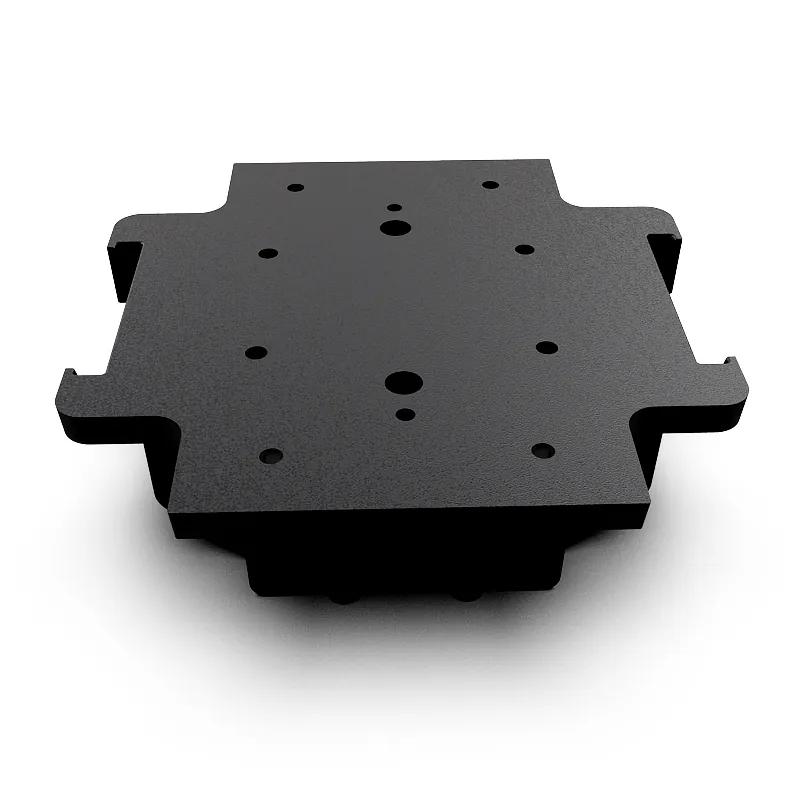
Aluminum die cast housing ready for export packing Sourcing review
Factory
Shenzhen, since 2014
Machines
20+ at 160–800 T, network
Metrology
2 CMM, X-ray
First reply
30 min, 09:00–21:00 CST

In one sentence

Verify before you share: the business license, the equipment list with tonnage, the metrology list and the tool-ownership clause — then make the first order a tool plus a T1 sample, not a container.

01 / Factory or reseller

What separates a die casting factory from a trading company?

The difference is not the website or the response time. It is who owns the machines, who builds the tool and who signs the inspection report. Five documents and one call settle it.

  • The business license. Registered name, unified social credit code and business scope should cover casting or manufacturing, not only sales. Match that name to the contract and the bank account; a mismatch is the most common warning sign in a China sourcing file.
  • The equipment list, with tonnage and model. The network we coordinate runs 20+ high-pressure die casting machines from 160 to 800 T and 30+ CNC machining centers. A reseller can quote a list it does not own, so ask for the nameplate on a live call.
  • Tooling in house. Die design and build is 15–25 days at our Shenzhen site. When the tool is outsourced, the schedule belongs to a third party you have never met and cannot audit.
  • Metrology. Two CMM units at 0.001 mm, one X-ray unit for internal porosity and one spectrometer for alloy verification. A supplier that cannot name its equipment cannot produce the report that travels with the lot.
  • Engineers, not only sales. 15+ tooling and process engineers. The person answering the RFQ should be able to read the drawing and ask about datums, draft and wall thickness.
02 / Remote verification

How do I verify a China die casting supplier without flying to Shenzhen?

Ask for these six items in one email. A real factory answers within a day or two; a reseller negotiates each item separately.

  • An unedited video walkthrough. Machine nameplates, the die storage rack and the CMM in the same session. A gallery of rendered images is marketing, not evidence; the photos and clips on our factory page are dated and say what each frame shows.
  • One real inspection record. A dimensional report from a production lot, with the drawing revision it was measured against and the operator date.
  • The tool-ownership clause. Who owns the tool, where it is stored, who pays maintenance, and what happens on transfer. Put it in the quotation, not in a call.
  • References under NDA. Country, part family and program stage are enough to start a reference call. Customer names are not published without written authorization — the same rule we apply to your drawings.
  • A bank account in the license name. Payment to a personal account or to a third-party company is a stop signal, regardless of the price.
  • An export record. 50+ countries with at least one delivered production order since 2014, and a 70%+ export share for the last full financial year (company-reported, records available under NDA).
A supplier that cannot show a lot-level inspection record before the order will not produce one after it.
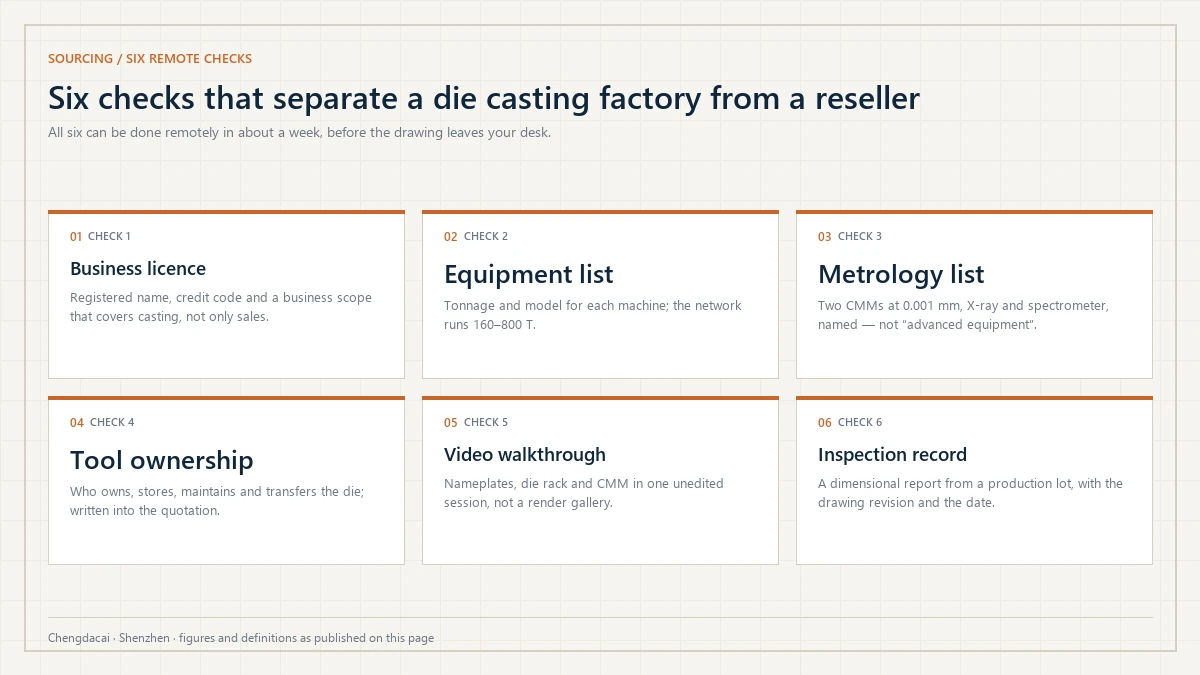
Six remote checks on a China die casting supplier: business license and export record, equipment list with tonnage, metrology list, tool ownership terms, an unedited video of the part running, and a real inspection report.
Six checks separate a factory from a reseller, and all of them can be done from a desk. Ask for the license and export record, the machine list with tonnage, the metrology list, the tool ownership terms, an unedited video of your part running, and a real first-article report rather than a certificate image.
03 / What the price includes

What does the “China price” actually include?

A price per kilogram is not a price for a part. Two quotations at the same alloy rate can differ by a factor of two once shot weight, machining content, finishing and packing are counted. Ask for a line-item quote, then compare the lines that matter for your drawing.

  • Term. FOB Shenzhen under Incoterms 2020 is our default; CIF and DDP are quoted when asked, with the named place and validity written in. Freight and duty are not inside the piece price.
  • Tooling. A separate line with cavity count, ownership, maintenance and transfer terms. It is not amortised silently into the part price unless you ask for that.
  • Alloy and shot weight. ADC12, A380, A360, Zamak 3 or Zamak 5 are different price points, and runner and overflow weight is part of the metal cost.
  • Machined content. Every face, bore and datum at ±0.01 mm adds an operation, a fixture and cycle time.
  • Finishing and packing. Powder coating, anodizing, plating and export packing are quoted separately so the options can be compared instead of blended.

Read what moves a die casting piece price for the cost model behind these lines.

04 / Drawing protection

How do I protect the drawing before it leaves my company?

Most leakage happens before production: a drawing sent to five suppliers “just for a price”. A short sequence removes most of the risk without slowing the quote.

  • NDA first, then the drawing. A mutual NDA is available on request and is normally signed before controlled drawings are exchanged.
  • Start from a 2D PDF with datums. A PDF is enough for a first feasibility and price range; native CAD and STEP go out only after the NDA is signed.
  • Send only the revision you are quoting. Rev letter, date and the features that changed, so no supplier quotes an obsolete model.
  • Nothing is published. Customer names, part numbers, drawings, tooling designs and project images are not published without written authorization. Our project pages are reference designs, not delivered customer programs.

How drawings and IP are handled sets out the NDA and project-file rules in full.

05 / Communication

How does communication work across time zones?

Our working day is 09:00–21:00 CST (UTC+8), which overlaps the start of the European morning and the end of the US West Coast day. During those hours the first reply to a new RFQ is within 30 minutes; outside them it is first thing the next morning.

  • An engineer replies, not a mailbox. The reply should contain questions about the drawing, not a brochure link.
  • Written change control. Rev letter, date, who approved and what changed — on both sides, before the tool is cut.
  • One thread per project. Purchase orders, drawing revisions and inspection records stay in one folder so a later dispute has a record.

A supplier that answers in days during the quotation will answer in weeks during production. Response time in the RFQ stage is a preview of the project stage.

06 / First order

What should a first order look like?

The first order is a tool and a sample, not a container. A supplier who pushes for volume before T1 approval is selling capacity, not a part.

  • Tool build: 15–25 days typical from approved DFM, depending on cavity count, slides and inserts.
  • T1 sample: 3–5 days after tool tryout, with a dimensional report against the drawing revision.
  • FAI and approval: the features that matter — sealing faces, bores, datums, wall thickness — measured and recorded before the pilot lot.
  • Pilot lot, then volume: production lead time is typically 7–15 days once material is released.
  • Every lot ships with a dimensional report; X-ray images where the drawing or the control plan specifies them.

The minimum order follows the tool: a single-cavity tool and a four-cavity tool have different economics, so no MOQ is published before the part is known. The first production run is quoted together with the tooling.

Buyer questions

Sourcing questions buyers ask before the first order

The answers that decide whether a supplier is worth a drawing.

No. For a multi-process assembly that combines casting, machining, finishing and electronics, a good trading company can absorb real coordination work. The condition is that you know which factory casts the part and can see that factory's equipment list and lot records.

Under NDA, yes: country, part family and program stage first, then a call if both sides agree. Customer names are not published without written authorization, which is the same rule that protects your project.

It follows the tool. A single-cavity tool and a four-cavity tool have different economics, so no MOQ is published before the part is known. The first production run is quoted together with the tooling, not after it.

Related pages

Continue through the project path.

Verification is the first step; the next pages cover the quote, the records and the RFQ.

Send the drawing. Get the engineering questions first.

Include the material, annual quantity, finishing requirement, destination country and delivery date. The review can start from STEP, IGS, DWG, DXF, PDF or ZIP files.

Request a quote
Upload drawing